 Upendra
 map vs flatMap
map
Transform the items emitted by an Observable by applying a function to each item. The Map operator applies a function of your choosing to each item emitted by the source Observable, and returns an Observable that emits the results of these function applications.
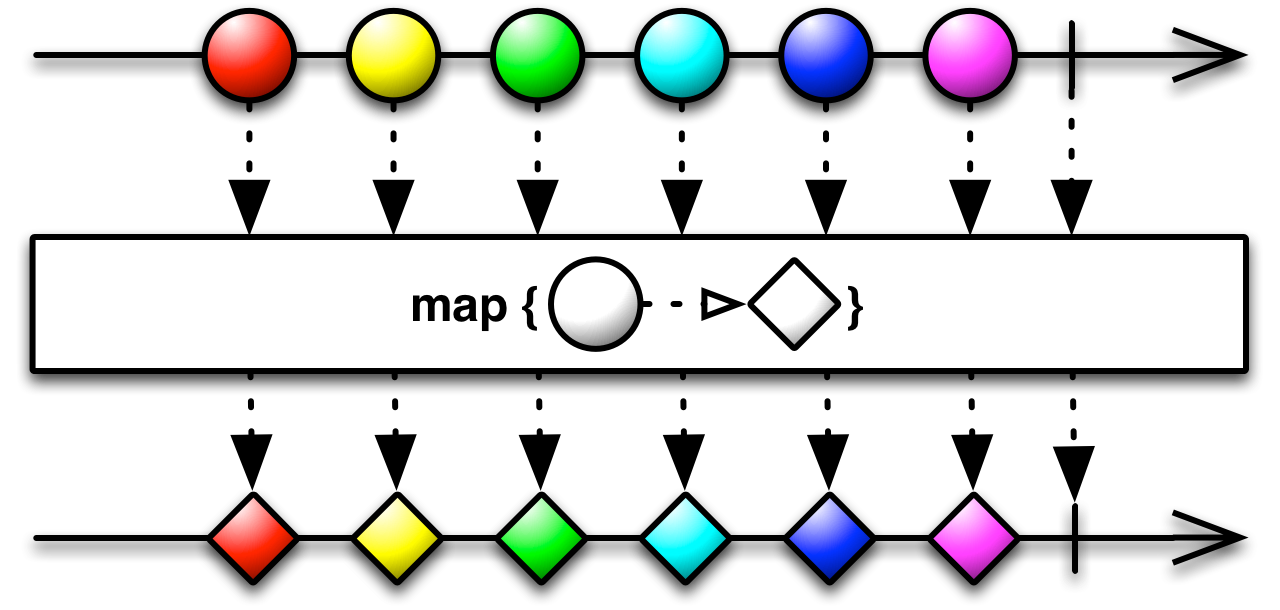
Example. Suppose we have the class Point which contains two values - x and y, and we want to display all x values from some amount of points:
data class Point(val x: Int = Random.nextInt(), val y: Int = Random.nextInt())

fun mapOperatorExample() {
  Observable.just(
    Point(),
    Point(),
    Point(),
  ) //Observable<Point>
    .map { it.x } //After applying `map()` function Observable<Point> transforms to Observable<Int>
    .subscribe { print(it) }
}
flatMap
Transform the items emitted by an Observable into Observables, then flatten the emissions from those into a single Observable.
The FlatMap operator transforms an Observable by applying a function that you specify to each item emitted by the source Observable, where that function returns an Observable that itself emits items. FlatMap then merges the emissions of these resulting Observables, emitting these merged results as its own sequence.
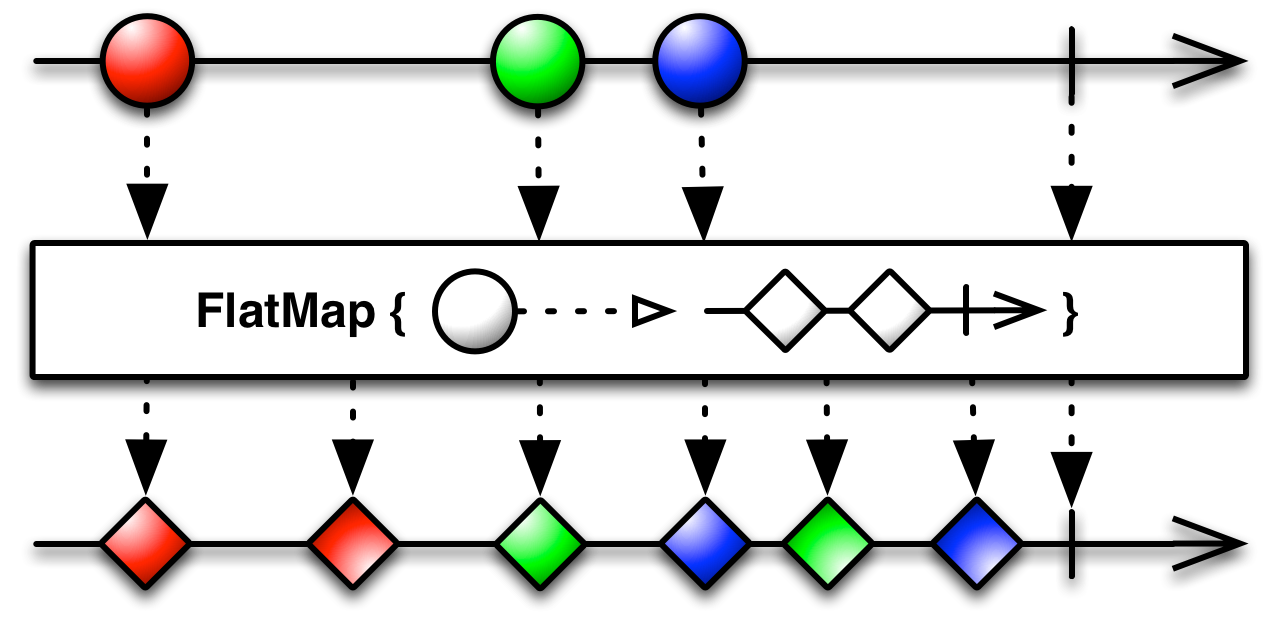
Example. Suppose we need to transform each element of initial Observable to it’s own Observable:
fun flatMapExample() {
    Observable.just("A", "B", "C")
            .flatMap { item ->
                println()
                Observable.just(item + "1 " + item + "2 " + item + "3")
            }
            .subscribe { items -> println("Next item = $items") }
}
Output:
Next item = A1 A2 A3
Next item = B1 B2 B3
Next item = C1 C2 C3
Difference
maptransform one event to another,flatMaptransform one event to zero or more event;mapemits single element andflatMapemits a stream of elements;mapmaps items to items,flatmapmaps observables to observables;maprecommended for transformation the event,flatMaprecommended if you plan to make an asynchronous call inside the method.
Links
When do you use map vs flatMap in RxJava?
Next Questions
Can you provide an example of transforming operators?
 Rx - concat