 Upendra
 List interface
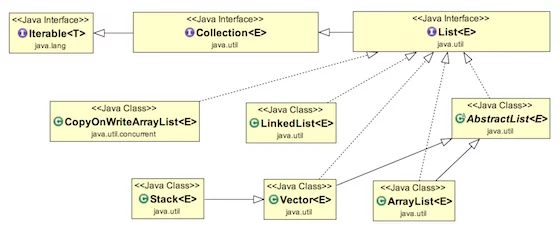
A List is an ordered Collection (sometimes called a sequence). Lists may contain duplicate elements. In addition to the operations inherited from Collection, the List interface includes operations for the following:
- Positional access — manipulates elements based on their numerical position in the list. This includes methods such as
get,set,add,addAll, andremove. - Search - searches for a specified object in the list and returns its numerical position. Search methods include
indexOfandlastIndexOf. - Iteration — extends Iterator semantics to take advantage of the list’s sequential nature. The listIterator methods provide this behavior.
- Range-view — The
sublistmethod performs arbitrary range operations on the list.
The Java platform contains two general-purpose List implementations. ArrayList, which is usually the better-performing implementation, and LinkedList which offers better performance under certain circumstances.
Like the Set interface, List strengthens the requirements on the equals and hashCode methods so that two List objects can be compared for logical equality without regard to their implementation classes. Two List objects are equal if they contain the same elements in the same order.
Most used Implementing Classes
- ArrayList. Resizable-array implementation of the
Listinterface. Implements all optional list operations, and permits all elements, includingnull. In addition to implementing theListinterface, this class provides methods to manipulate the size of the array that is used internally to store the list. (This class is roughly equivalent toVector, except that it is unsynchronized.) - LinkedList. Doubly-linked list implementation of the
ListandDequeinterfaces. Implements all optional list operations, and permits all elements (includingnull). All of the operations perform as could be expected for a doubly-linked list. Operations that index into the list will traverse the list from the beginning or the end, whichever is closer to the specified index. - Vector. The
Vectorclass implements a growable array of objects. Like an array, it contains components that can be accessed using an integer index. However, the size of aVectorcan grow or shrink as needed to accommodate adding and removing items after theVectorhas been created. Vectors basically fall in legacy classes but now it is fully compatible with collections. - Stack. The
Stackclass represents a last-in-first-out (LIFO) stack of objects. It extends classVectorwith five operations that allow a vector to be treated as a stack. The usual push and pop operations are provided, as well as a method to peek at the top item on the stack, a method to test for whether the stack is empty, and a method to search the stack for an item and discover how far it is from the top. When a stack is first created, it contains no items.
Iterators
Iterator returned by List’s iterator operation returns the elements of the list in proper sequence. List also provides a richer iterator, called a ListIterator, which allows you to traverse the list in either direction, modify the list during iteration, and obtain the current position of the iterator.
The three methods that ListIterator inherits from Iterator (hasNext, next, and remove) do exactly the same thing in both interfaces. The hasPrevious and the previous operations are exact analogues of hasNext and next. The former operations refer to the element before the (implicit) cursor, whereas the latter refer to the element after the cursor. The previous operation moves the cursor backward, whereas next moves it forward.
Here’s the standard idiom for iterating backward through a list:
for (ListIterator<Type> it = list.listIterator(list.size()); it.hasPrevious(); ) {
    Type t = it.previous();
    ...
}
Note the argument to listIterator in the preceding idiom. The List interface has two forms of the listIterator method. The form with no arguments returns a ListIterator positioned at the beginning of the list; the form with an int argument returns a ListIterator positioned at the specified index. The index refers to the element that would be returned by an initial call to next. An initial call to previous would return the element whose index was index-1. In a list of length n, there are n+1 valid values for index, from 0 to n, inclusive.
Conclusion
List are:
- Member of the Java Collections Framework;
- Allows you to add duplicate elements;
- Allows you to have
nullelements; - Indexes start from 0, just like arrays;
- Supports Generics;
Links
Next questions
What you know about ArrayList?
What you know about LinkedList?
What is the difference between ArrayList and LinkedList?
 Java - deque_interface_java